
Blog › AI search
AI search for law firmsDoes ChatGPT recommend your law firm? How to check in 10 minutes

By Michael O’Grady, founder of Verdict Digital Marketing · 15+ years in legal marketing · November 2026
To check whether ChatGPT recommends your law firm, ask it what a prospective client would ask (a practice area and a city, no firm name) in a fresh, logged-out chat. Then ask about your firm by name. Being known and being recommended are two different results, and only the second brings in cases.
TL;DR
- Run three prompts: two that ask for a lawyer without naming your firm, and one that asks about your firm by name.
- Use a clean session and the same wording on every platform. Save the full answer and its sources, not a screenshot.
- If ChatGPT can describe your firm but won’t shortlist it, fix your details across legal directories before you write more content.
Rather have us run it? Ask for a free AI visibility check.
Why does it matter whether ChatGPT recommends your law firm?
Whether ChatGPT recommends your law firm matters because people now ask AI tools for legal help before they call anyone. When someone asks ChatGPT for a lawyer, the answer names a handful of firms, not ten blue links. If yours isn’t one of them, that person may never reach your website.
The numbers are moving fast. Clio’s 2026 Legal Trends Report found nearly one in four U.S. adults has used AI to answer a legal question, and 46% say they’d consult AI before contacting a lawyer. In Clio’s 2025 research, 28% of people who used AI for a legal question were prompted to contact a lawyer.
It’s tempting to assume your Google rankings carry over. They don’t, not reliably. Ranking #1 on Google for a keyword doesn’t mean ChatGPT will mention your firm for that same search.
It cuts the other way too. I’ve seen a firm that didn’t rank well on Google, with poor local citations (its listings in directories and on map sites), still get recommended in AI answers. What it did have was mentions on other websites.
So it’s worth ten minutes to find out. Not a vendor’s score, and not a screenshot someone forwarded you. Your own check, done in a way you can repeat next month.
What prompts show whether ChatGPT recommends your law firm?
Three prompts are enough to show whether ChatGPT recommends your law firm. The first two ask for a lawyer the way a prospective client would, with a practice area and a city but no firm name. The third asks about your firm by name. The first two test the shortlist. The third tests recognition.
Does ChatGPT pick you on its own, for your practice area and your city?
Do you show up when someone describes their situation instead of naming a legal category?
What does ChatGPT know about you, and where did it learn it?
Fill in the brackets and leave the rest of the wording alone. Write the practice area the way a client would type it: “car accident,” “DUI,” “divorce.” Nobody asks ChatGPT for a “plaintiff-side tort litigation firm.”
I also run a couple of shorter, searcher-style prompts, because real people don’t always type full paragraphs: “best car accident lawyer in [city]” and “recommend an experienced personal injury lawyer in [city].”
| Prompt | What it tests | What a bad result looks like |
|---|---|---|
| 1. Shortlist | Whether ChatGPT recommends you without being told your name | Three firms named. None of them yours. |
| 2. Problem | Whether you appear when the question is a situation, not a practice area | Other firms, a directory or generic advice, but not you |
| 3. Your name | Whether ChatGPT recognizes your firm and has its details right | An old firm name, an old address, attorneys who left, or “I couldn’t verify this” |
How do you check ChatGPT for your law firm in 10 minutes?
Open a fresh, logged-out ChatGPT session, run the three prompts in separate chats, and save every answer with its sources. Ten minutes covers ChatGPT. Run the same prompts on Gemini, Perplexity and Google when you have a few more minutes, because a result on one platform tells you nothing about the others.
- Step 1 · Minute 0 to 1
Start clean
Open a private browser window, logged out, with no earlier conversation about your firm. If you test inside an account that has already chatted about your firm, ChatGPT can hand your name right back to you.
- Step 2 · Minutes 1 to 4
Run the shortlist prompt
Paste prompt 1. Write down every firm named, in order, and every source linked. Don’t follow up with “what about [your firm]?” That’s a different test, and it spoils this one.
- Step 3 · Minutes 4 to 6
Run the problem prompt in a new chat
Describe a problem your firm actually handles, in everyday words. “I was rear-ended and my back still hurts” is closer to how a client talks than “motor vehicle negligence.”
- Step 4 · Minutes 6 to 8
Run the name prompt in another new chat
Read it for errors: an old firm name, an old address, attorneys who left, practice areas you dropped. Note anything ChatGPT says it can’t verify. Those gaps are clues.
- Step 5 · Minutes 8 to 10
Record everything
Copy the full answers and sources into a sheet: date, platform, exact prompt, firms named, whether you were named, sources cited, and anything it got wrong about you. Keep the wording on file so next month’s check asks the same question.
That’s ChatGPT done. Running the same five steps on Gemini, Perplexity and Google’s AI Overviews turns one data point into four.
What should you look for first in ChatGPT’s answer about your firm?
Look first at whether ChatGPT describes your law firm accurately, and what sources support that description. Where the firm sits in the list comes second. Check the practice areas, attorneys and locations, then open the linked sources to see what they actually say. An answer that ranks you first but describes you wrongly isn’t a win.
Does the answer identify the right practice areas, attorneys and locations? Are the reasons for recommending the firm specific and supported, or just generic language? Then I open the linked sources to see what they actually say.
Some things deserve investigation the moment I see them:
- An old addressThe AI is working from listings you haven’t updated.
- A departed attorneyOld bios and directory profiles are still out there.
- The wrong practice areaYour pages or profiles aren’t clear about what you do.
- A source about a different firmThe recommendation rests on evidence that isn’t yours.
- A citation that doesn’t support the claimThe link is there, but the page doesn’t say what the answer says it does.
I record the order firms appear in, but I don’t treat one answer as a fixed ranking. Being listed first doesn’t mean much if the description is wrong, or if the recommendation is for work the firm doesn’t want.
My first question is: “Is the firm being represented accurately, for the right services, with evidence behind the recommendation?” Then I look at visibility and competitive gaps.
Why can ChatGPT describe your law firm but not recommend it?
ChatGPT can describe your law firm correctly and still leave it off the shortlist, because knowing a firm and choosing it are separate decisions. Asked by name, it finds you. Asked for a lawyer in your practice area and city, it needs reasons to pick you over everyone else. Sometimes it doesn’t have them.
This was the biggest surprise in my own testing. ChatGPT described a well-known firm accurately when I asked about it by name. Then I asked for a lawyer in one of its practice areas, in its city. The firm wasn’t on the list.
The firms ChatGPT named instead each focused on that practice area. This firm handled too many and didn’t specialize the way they did. Everyone knew the name. Nothing told the AI it was the obvious choice for that one kind of case.
It happens at the location level too. In a recent logged-out check for a firm with three offices, ChatGPT recommended it in two of its cities and left it off the shortlist in the third. Here’s that third city.
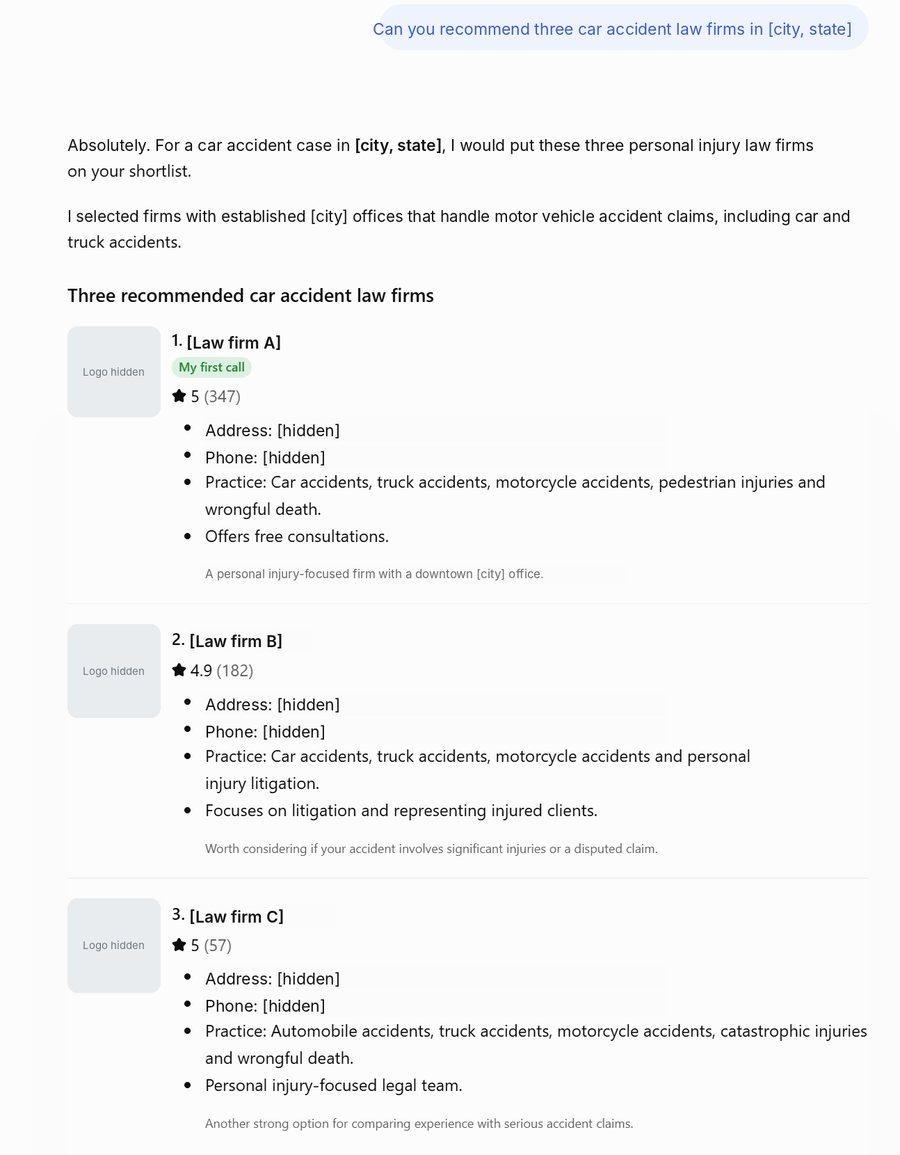
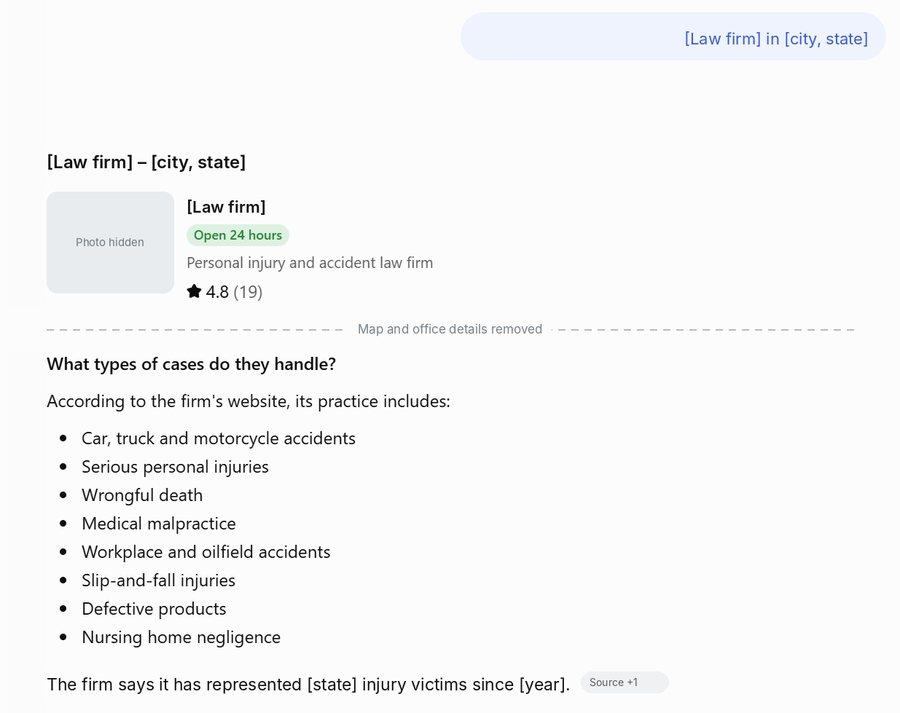
Look at that practice list next to the shortlist. The three firms ChatGPT recommended were each described around accident cases. The firm it left out lists eight practice areas, from car accidents to medical malpractice and nursing home negligence. One screenshot doesn’t prove why it was skipped. But it’s the same pattern I described above.
So I treat it as two tests, not one:
Can it find you?
Prompt 3. ChatGPT recognizes the firm and gets the details right.
Does it put you on the shortlist?
Prompts 1 and 2. ChatGPT names you when nobody told it to.
It’s easy to run only the first test. You type your own firm’s name, get a flattering paragraph back and call it done. That paragraph proves recognition. It doesn’t prove anyone is being sent your way.
In SEO terms, your firm is an entity: a distinct thing, with a name, address, attorneys and practice areas, that search engines and AI tools can recognize. Passing prompt 3 means ChatGPT recognizes the entity. Getting shortlisted means it has enough evidence to recommend that entity for a specific legal problem in a specific place.
Do Gemini, Perplexity and Google AI Overviews recommend the same firms as ChatGPT?
Don’t expect the same shortlist everywhere. ChatGPT, Gemini, Perplexity and Google’s AI Overviews can name different law firms for the same question. Compare the firms each platform names and the sources each one cites, rather than assume a good result on ChatGPT means you’re visible across every AI tool.
The useful question isn’t just “Did we appear?” It’s “What evidence did this platform use?”
In my testing, results change by platform, location and phrasing. Lawyer and “top-rated lawyer” prompts have pulled from Avvo, and other local third-party websites play a part in which attorneys get recommended. Reddit, LinkedIn and Quora show up as sources too, depending on the platform and the question.
One caution: a citation isn’t a recommendation. A platform can cite a directory that lists your firm and still name three other firms in the answer. Count the two separately.
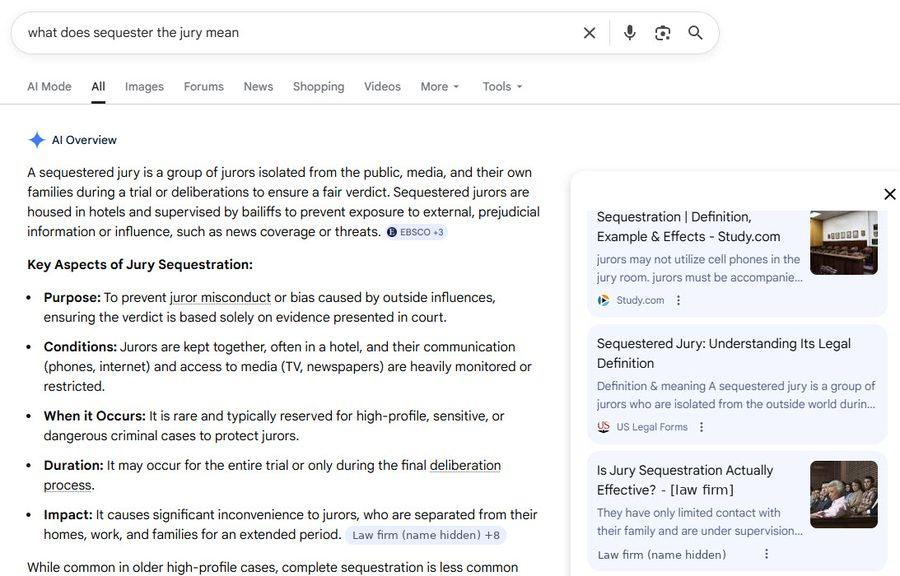
For more on how each platform behaves, see the platform comparison in our AI search guide.
What mistakes do law firms make when they test ChatGPT?
The biggest mistake law firms make when testing ChatGPT is putting the answer in the question. Asking “Is Smith & Jones a good divorce firm?” tells you nothing about whether ChatGPT would have named Smith & Jones on its own. The second biggest is testing in a chat that already knows about the firm.
- Naming the firm in the promptYou’ve told ChatGPT who to talk about, so it talks about you.
- Testing in a personalized sessionPast chats about your firm leak into the answer. Use a fresh, unpersonalized window every time.
- Leaving out the city or practice area“Recommend a good lawyer” gives the tool nothing to choose with. Be as specific as a real client.
- Changing the wording between platformsThen you’re comparing two questions, not two platforms.
- Keeping one screenshotThe answer where you appeared is the least useful one to save. Record every answer, including the misses.
Fixed wording does have a cost. It lets you compare platforms and months, but real clients don’t all type the same sentence, so a fixed set can miss how people actually ask. My answer is to lock the three core prompts and add the shorter searcher-style prompts on top. Keep tweaking the core three, and you’ll never know whether a change came from the AI or from you.
What should a law firm fix first if ChatGPT doesn’t recommend it?
If ChatGPT doesn’t recommend your law firm, fix your firm’s basic information before you publish anything new. What the firm does, where it practices and which attorneys work there should be clear and consistent everywhere it appears. Then look at the sources cited for the firms that did get named. That shows you what to fix.
Before anyone writes another blog post, look for:
- Outdated directory profiles
- Conflicting addresses across listings
- Vague practice-area pages that never say who you help or where
- Attorney bios that don’t establish relevant experience
Don’t skip the bios. I’ve seen thin attorney bios keep a firm from being mentioned in AI results. If a bio doesn’t say which cases a lawyer handles, nothing connects that lawyer to the practice area.
Then make your NAP (name, address and phone number) and attorney profiles match across the core legal directories: Avvo, Justia, FindLaw, Martindale-Hubbell and Super Lawyers, plus your Google Business Profile. The Google side is covered in our local SEO chapter.
If your firm changed its name or moved, start there. In my experience, AI tools tend to recommend whichever name or address is better known, so years of old listings can outvote your new sign. Cleaning up listings has helped firms get cited more and get their current name used within a few weeks to a few months. Not overnight, and nobody can guarantee it.
| What you see | What it usually points to | Fix first |
|---|---|---|
| Prompt 3 gets your details wrong | Conflicting or outdated information about the firm online | Directory profiles, Google Business Profile and old listings |
| Prompt 3 is right, but you’re missing from prompts 1 and 2 | ChatGPT knows you but has no strong reason to choose you for that practice area and city | The sources cited for the firms it named, then your practice-area pages and attorney bios |
| You show up on ChatGPT but not elsewhere | Each platform is leaning on different sources | Compare the cited sources platform by platform |
| You’re missing everywhere and prompt 3 says little | Not much third-party information about the firm exists yet | Complete core directory profiles and build reviews before adding content |
Don’t reach for more content first
The reflex when a firm is missing from AI answers is to order more blog posts. I’d hold off. If prompt 3 gets your details wrong, new content adds one more page to a pile of conflicting information.
If prompt 3 is right and you’re still missing, open the sources cited for the firms that got named. A directory you aren’t on. A local “best lawyers” list. A review gap. That’s a to-do list. Guessing you need more blog posts isn’t.
When is a 10-minute ChatGPT check not enough?
A 10-minute ChatGPT check is a snapshot, not a measurement. AI answers shift by day, location and phrasing, so a single run can’t tell you whether you’re improving. Once you’re making changes, or once you have several offices or practice areas, you need the same prompts run on a schedule.
That’s the job of our in-house AI tracker, the Verdict AI Citation Tracker. It runs 15 fixed prompts across ChatGPT, Perplexity, Gemini and Google AI Overviews every week: 60 checks a run. It counts mentions, owned citations (your own pages linked as a source), competitor citations, share of voice and gap prompts, where competitors get cited and you don’t.
We use it for the free AI visibility check and in monthly client reporting. The method is laid out in the measurement section of our AI search guide.
Even a careful hand check is small. For one Verdict client, we ran five unbranded prompts in a logged-out private window across Google AI, ChatGPT, Gemini and Perplexity. The firm was named in about four of the five. Useful, and still only five prompts. Read the case study.
And if your firm is new, with few reviews and little written about it elsewhere, the check will mostly confirm what you suspect. There isn’t much for ChatGPT to find yet.
ChatGPT and law firm recommendations: FAQ
Does ranking #1 on Google mean ChatGPT will recommend my law firm?
No. Ranking #1 on Google for a keyword doesn’t mean ChatGPT will mention your firm for that search. The two weigh different evidence, which is why you test ChatGPT directly instead of assuming your rankings carry over.
How often should a law firm check whether ChatGPT recommends it?
For most firms checking by hand, once a month is enough. Our tracker runs weekly because we report on it, and AI answers can change from one day to the next. Also rerun the same prompts after any big change, such as a new office, a name change or a directory cleanup, so you can see whether it moved anything.
Should I ask ChatGPT about my firm by name first?
No. Ask by name last, in its own chat. If you name the firm first, the rest of that conversation is contaminated and the shortlist prompts will hand your name back to you.
One uncomfortable truth. If ChatGPT only mentions your firm when someone types your name, it isn’t recommending you. It’s looking you up. Those people already found you somewhere else. The ones who don’t know your name yet are the clients you’re missing.

About the author
Michael O’Grady founded Verdict Digital Marketing, which has worked with law firms since 2014 (it started as Verdict SEO). He has 15+ years in legal marketing, moved to search intent and semantic SEO in 2015, and started using ChatGPT and other AI chatbots in his work in 2024. Connect on LinkedIn.

Want us to run the check for you?
Start with a free AI visibility check. We’ll run your prompts through ChatGPT, Gemini, Perplexity and Google, show you which firms get named and which sources the AI used, and tell you what to fix first.
Founded in 2014. We work only with law firms. Offices in West Caldwell, NJ and Hicksville, NY.